John Galliano Joins Zara and the New Face of Fast Fashion Luxury
The fashion industry has always had a short memory when it comes to controversy, but even by its own standards, the announcement that John Galliano is partnering with Zara landed with unusual force. A year after departing Maison Margiela, where he spent a decade reshaping the language of couture through spectacle and technique, Galliano is stepping into a two-year collaboration with one of the world’s most powerful fast fashion machines. The proposition is simple, at least on paper: to rework Zara’s extensive archive into new seasonal pieces. The reaction, however, has been anything but.

To understand the weight of this moment, it helps to recall the arc of Galliano’s career. Once the theatrical genius behind Dior, his fall from grace in 2011 was as public as his rise, following widely reported antisemitic remarks that led to his dismissal and a long period of rehabilitation. His return, carefully stewarded over the years and examined in High & Low: John Galliano, has been framed as one of fashion’s more complex redemption stories. At Margiela, he rebuilt his reputation through work that was, at its best, uncompromising. That makes his pivot to Zara feel less like a natural progression and more like a rupture.
And yet, the logic is not entirely new. Fast fashion has spent the past two decades courting luxury credibility through collaborations, most notably via H&M, whose designer partnerships once generated queues that stretched around city blocks. When Bad Bunny appeared in a custom Zara look during Super Bowl weekend, it signalled a different kind of ambition. Not just accessibility, but relevance. Not just fashion, but visibility at the highest level of global entertainment.
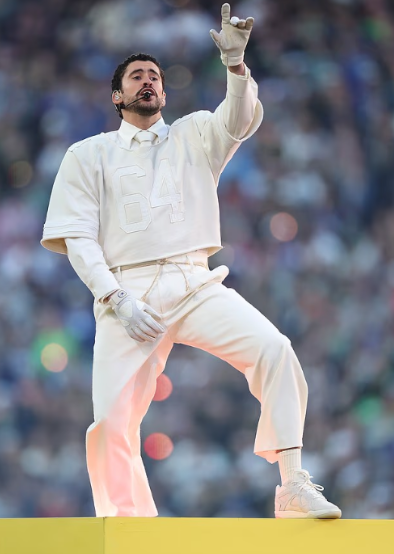
Bad Bunny in a Zara outfit at the SuperBowl
Set against that backdrop, the arrival of John Galliano feels less like an isolated collaboration and more like a continuation of a broader repositioning. Zara is no longer simply borrowing from luxury. It is attempting to sit adjacent to it.


Zara x Kate Moss in 2025
The timing is telling. The fast fashion model is under pressure from all sides. Brands like H&M, Zara, Mango, Boohoo and ASOS are grappling with shrinking margins, rising production costs and a consumer base that is increasingly conflicted about sustainability. Into this already strained ecosystem steps Shein, whose scale and speed have effectively rewritten the rules of profitability. Competing on price has become a race to the bottom. Competing on image, however, is still up for grabs.
This is where the Galliano partnership begins to make sense. As these companies attempt to edge toward a more “elevated” positioning, borrowing the language of quiet luxury while maintaining the operational realities of fast fashion, collaborations with revered designers offer a shortcut to cultural legitimacy. They allow brands to signal craft, heritage and creativity without fundamentally altering the systems that underpin their business. It is, in many ways, a form of aesthetic arbitrage.
But the risks are equally clear. The industry has become adept at cloaking itself in the language of responsibility, often without meaningful structural change. Terms like “archive,” “rework” and “limited” carry the suggestion of restraint, even when attached to a model built on volume. The concern is not simply that this collaboration will produce more clothes, but that it will produce them under the guise of something more thoughtful than they are. Greenwashing, once a clumsy exercise, has become increasingly sophisticated.
There is also a cultural tension that is harder to ignore. For some, the collaboration represents a kind of democratisation, an opportunity to access the vision of a designer who has historically operated at a rarefied level. For others, it signals the erosion of what made that vision valuable in the first place. The idea that one might bypass this entirely by purchasing vintage pieces from Maison Margiela or Dior is appealing in theory, though far less accessible in practice, where scarcity and resale markups place such items firmly out of reach for most.
What lingers, ultimately, is a sense of ambivalence. Galliano’s involvement guarantees a certain level of creative intrigue; even within constraints, he is unlikely to produce anything entirely devoid of interest. But the broader context cannot be ignored. At a moment when the fashion industry is being asked to reckon with its environmental and ethical impact, this partnership feels like both a clever strategy and a troubling signal.
It suggests that, rather than fundamentally changing, fast fashion may simply be getting better at telling its story.