Why Is Dolce & Gabbana So Controversial? A Timeline of the Brand's Biggest Scandals
Introduction
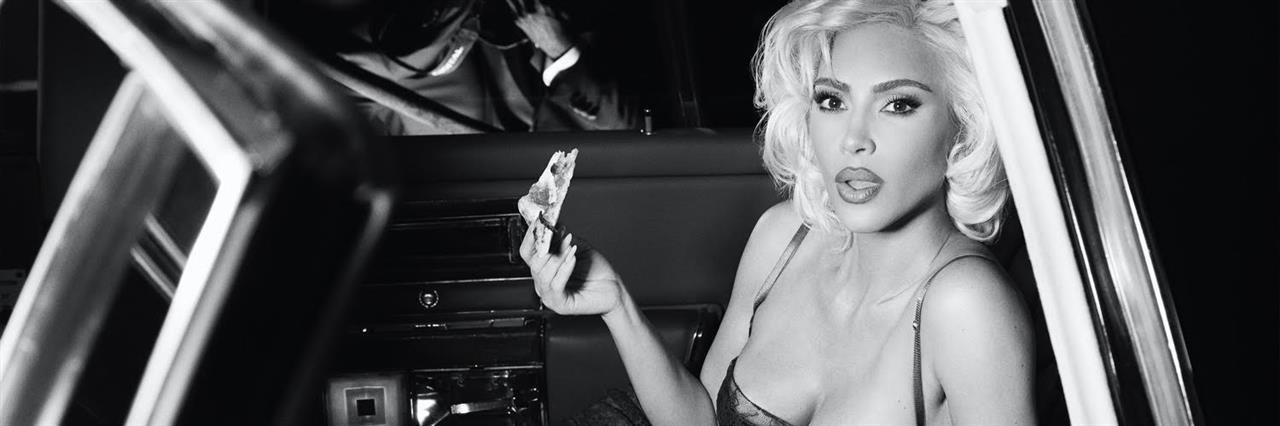
A few days ago we witnessed the birth of a new very unexpected collaboration - this of Dolce & Gabbana and Kim Kardashian. A collaboration no one in the world ever thought we needed to see or wish existed, yet now it does and I just had to sit down and write about it the moment I was done torturing myself watching the catwalk. I would like to say I was shocked to see Kim work with the designers considering their misogynistic, racist and homophobic patterns (I mean she is a lawyer), but without Kanye to guide her in the right direction when it comes to fashion, I guess this is only the beginning. In today’s article unlike any other before I just quickly wanted to remind everyone of all the times D&G did wrong. Strap yourself in and get ready for this emotional rollercoaster featuring defamation suits, tax evasion, racism, misogyny, internalised homophobia and online bullying.
It is insane seeing major fashion outlets minutes after the show titled 'Ciao Kim' publishing articles describing the show as ‘’epic’’, ‘’spectacular’’, ‘’the next level’’ to just quote a few from Elle and Vogue. We are all in when it comes to brands learning and improving but the below will prove quite the opposite for the brand as it completely missed the marks for about 15 hours and cancel culture clearly did not do its job the right way as we are still here talking about it.
Dolce & Gabbana's Rise to Global Luxury Status
It is an Italian luxury fashion brand established in 1985, with a first official runway show titled Real Women - if this is not a sign of a disastrous future that would follow about 25 years later, I don’t know. Although having said that since it happened back in the 80s trans rights weren’t really a thing so most likely this was not a reference to a secret allyship with J. K. Rowling, but simple ignorance. According to Wikipedia, the brand didn’t see much success until the early nineties with their 1940s inspired campaign and later in 1996 winning an award for best men’s fragrance.
In the early 2000s the brand had climbed to fame with a turnover of more than 500 million euro, working with celebrities like Madonna, Missy Elliott, Beyoncé, and Mary J. Blige. The brand pretty much shaped the decade and this is the first time we started witnessing some of the red flags.
2007: The Advertising Campaign Accused of Glorifying Violence
In 2007 they launched a campaign which showed a woman being pinned down by the wrist by a man, Italian unions unionised and called for a boycott, and Amnesty international asked for the campaign to be withdrawn saying it risked “excusing violence against women”. Both Spain and Italy banned the ad before it even aired.
2010: The Tax Fraud Investigation
In 2010 the D&G were indicted for alleged tax fraud and convicted by two separate Italian courts. And after being sentenced to 20 months in prison, they appealed and as it usually happens with overly rich people - all charges were overturned by the Italian high court.
2012: The Blackamoor Jewellery Controversy
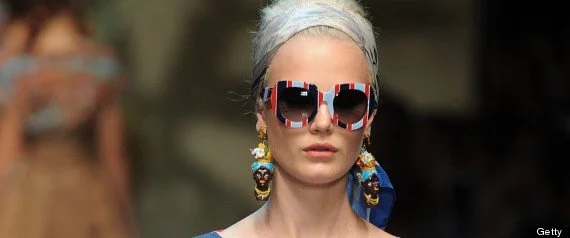
In 2012 they presented their Blackamoor earrings inspired by… colonialism. As the Guardian beautifully put it “There’s nothing cute about two white men selling minstrel earrings to a majority non-black audience. There wasn’t a single black model in Dolce & Gabbana’s show, and it’s hard not to be appalled by the transparent exoticism in sending the only black faces down the runway in the form of earrings.”
2015: Comments About Gay Parenting and IVF
In 2015 they made comments about gay parenting (“The only family is the traditional one”) and IVF (“children of chemistry”) which received massive backlash fuelled additionally by personalities such as Elton John voicing their opinion on the matter.
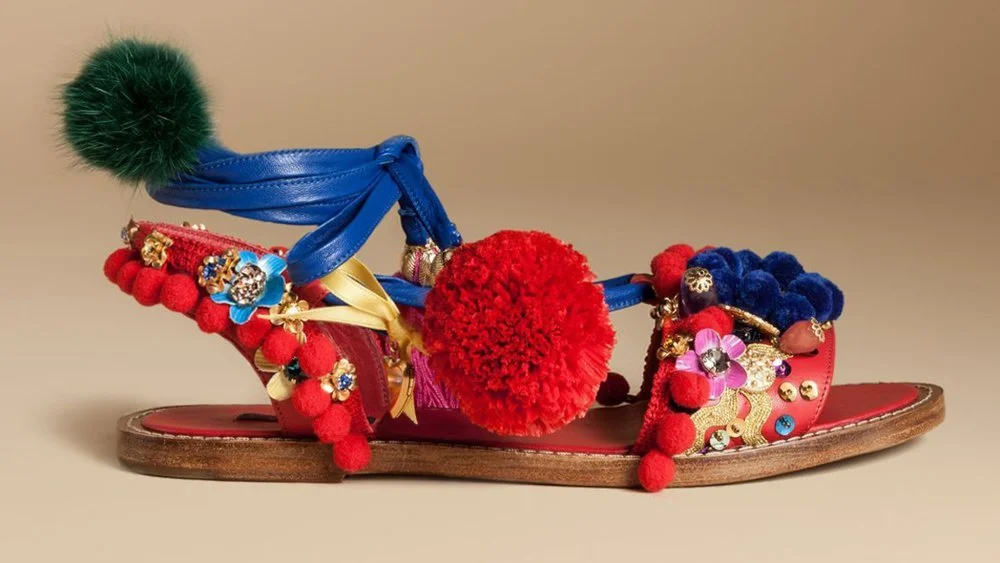
In 2016 their website revealed an exclusive pair of sandals titled ‘’slave sandals’’, their name was swiftly changed and business continued as usual.
2017: Melania Trump and Political Backlash
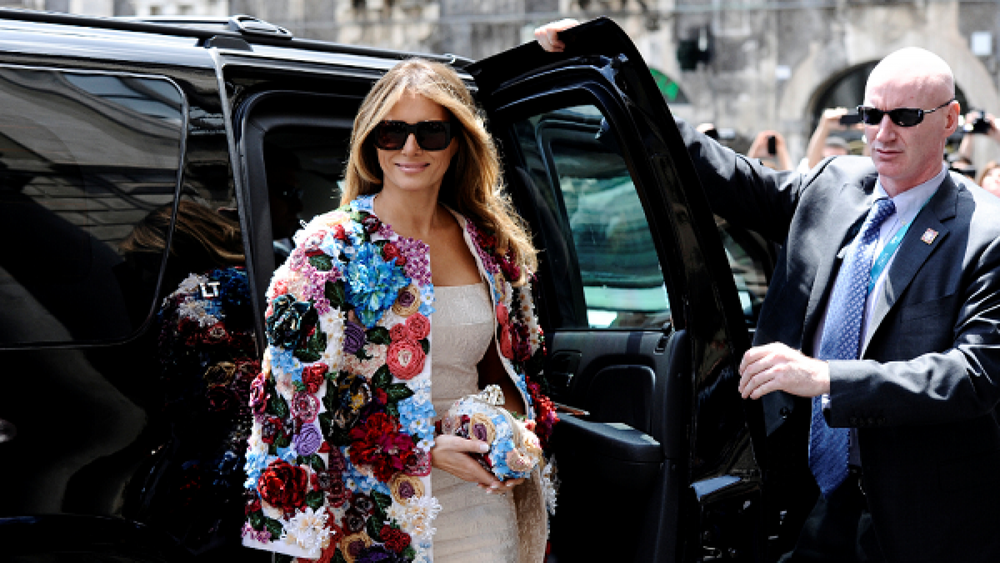
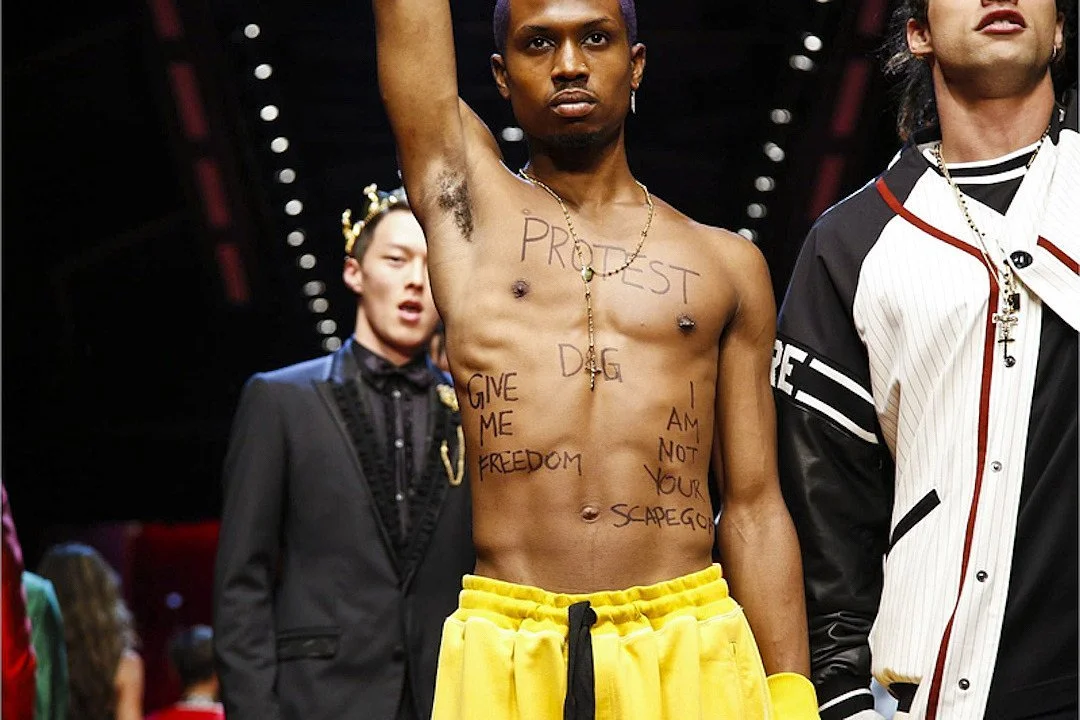
In 2017 when Melania became first lady and all American designers refused to dress her, D&G stepped in. When literal protests were being carried out across the US, the designers put the slogan on a t-shirt and sold it mocking free speech. Later called out by a rapper called Raury as he walked their catwalk. He only found out about the entire boycott the night before the show but still managed to come up with his own plan to show support. (Hence why it is important to keep celebrities and media accountable).
2017: "I'm Thin and Gorgeous" Sneakers
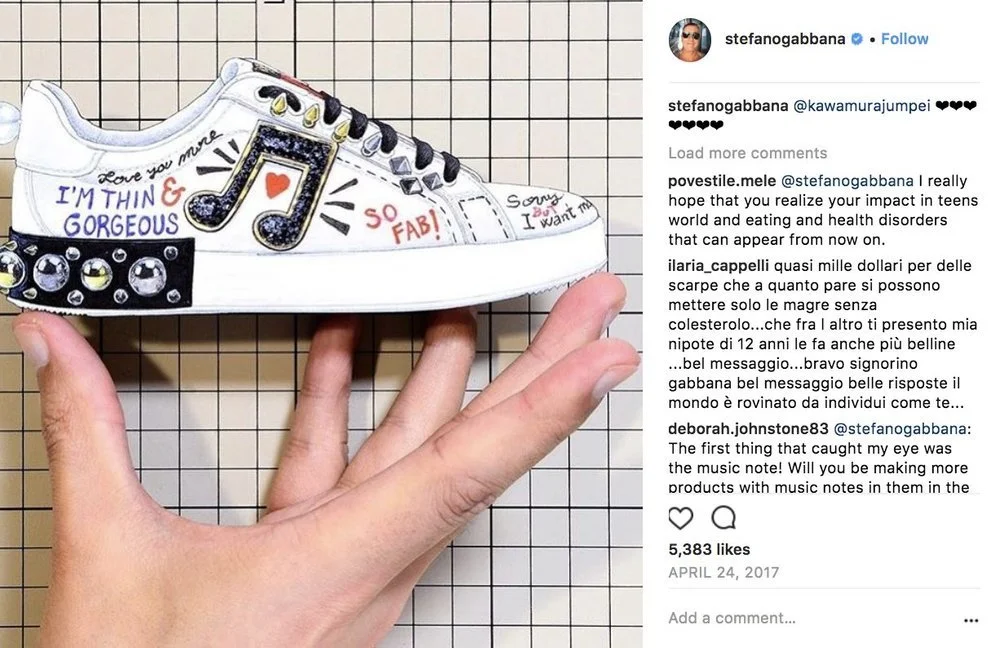
In 2017 they thought it was cute to promote body dysmorphia by releasing sneakers that read ‘’I’m thin & gorgeous’’. The response the designers gave was less than satisfactory with “Darling you prefer to be fat and full of cholesterol ??? I think u have a problem.”
2018: The China Advertising Scandal
In 2018 they had one of their biggest years to date when they somehow managed to offend an entire nation. Many of you might have come across this one featuring a Chinese model attempting to eat Italian cuisine with chopsticks, while a male narrator asks “is it too huge for you?”. Stefano Gabbana, the blessed outspoken soul he is, allegedly made multiple racist and extremely offensive remarks about Asian people in DM’s that were shared across multiple screenshots on social media and by the popular social media account Diet Prada. Instead of apologising (which would have probably achieved nothing considering the level at which he played it) he just said that someone hacked his account.
In 2018 Stefano told Reuters that “I don't want a Japanese designer to design for Dolce & Gabbana" regarding succession plans which promptly raised accusations of alleged racism, very surprising.
Dolce & Gabbana vs Diet Prada
In 2018 the designer duo felt appropriate to file a defamation suit against Diet Prada seeking approximately $800 million for loss of business which clearly the designers are too blind to see is caused by their own doing or the lack there of.
In 2018 he made sure that everyone knew he was not a Selenator by commenting under a Selena Gomez’s photo calling her ‘’ugly’’.
The same year he also wrote under a Kate Moss’s photo just to say ‘’No’’
And to end it on a high and make everyone think for a second, they literally called the Kardashians “most cheap people in the world,” to now literally try and cash grab from their millions of fans.
With all the above, a few questions come to mind: Why is Kim Kardashian collaborating with them now, or how much is she getting paid to do it? Why are major media outlets not limiting the exposure of this brand to their audiences? And why are consumers still buying into a racist, homophobic, misogynistic brand?
From the wall of shame to the wall of forgiveness:
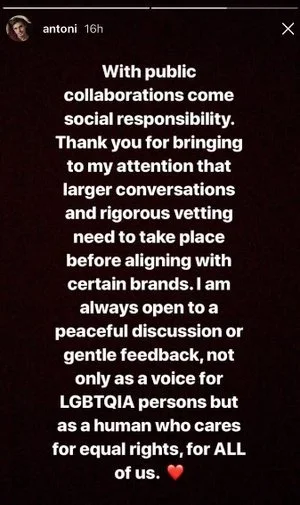
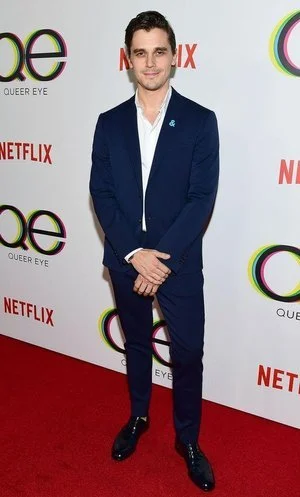
It is important to note that after a push from their audience both Antoni Porowski and Tan France dissociated themselves from the brand. So if you were one of those sat at home thinking there was not much you could do, you are wrong, not only does your wallet speak but so does your social media presence. Look out for the celebrities you support, always keep them accountable. Go ask Kim what’s good and let us know what you think below.
Why People Continue to Buy Dolce & Gabbana
Despite years of controversy, Dolce & Gabbana remains one of the most commercially successful luxury fashion houses in the world. The brand's enduring appeal stems from a combination of factors: a highly recognisable aesthetic, strong celebrity relationships, deep roots in Italian craftsmanship, and a loyal customer base that separates the product from the founders' public statements.
For many consumers, Dolce & Gabbana represents a particular vision of Mediterranean glamour that few luxury brands have managed to replicate. Its Sicilian-inspired tailoring, maximalist prints, corsetry, and unapologetically glamorous approach to fashion continue to resonate with shoppers seeking an alternative to the minimalism that has dominated much of luxury fashion over the past decade.
The brand has also benefited from the reality that public controversies do not always translate into long-term commercial consequences. While individual scandals have triggered boycotts and criticism, many luxury consumers either remain unaware of the controversies or ultimately prioritise design, craftsmanship, and brand heritage over corporate conduct.
At the same time, Dolce & Gabbana continues to attract celebrity endorsements and high-profile collaborations, ensuring that the brand remains visible within popular culture. From global musicians and actors to social media personalities and reality television stars, the house has consistently leveraged celebrity influence to maintain its relevance with new generations of consumers.
Whether this represents consumer forgiveness, selective memory, or the enduring power of luxury branding remains a subject of debate. What is clear is that controversy alone has not been enough to diminish Dolce & Gabbana's position within the global luxury market.
Has Dolce & Gabbana Repaired Its Reputation?
The answer depends largely on where you look.
In Western fashion circles, many of Dolce & Gabbana's past controversies continue to be referenced whenever the brand launches a major campaign, stages a runway show, or announces a celebrity partnership. The China advertising scandal in particular remains one of the most significant reputational crises faced by a modern luxury brand and is still regularly cited in discussions about cultural sensitivity within fashion.
However, the years since have also demonstrated the industry's remarkably short memory. Dolce & Gabbana continues to show at major fashion weeks, dress celebrities for red carpets, attract luxury consumers, and generate substantial global revenue. New product launches frequently receive extensive media coverage, often with little reference to the controversies that once dominated headlines.
The brand has attempted to rebuild its image through charitable initiatives, cultural partnerships, celebrity collaborations, and a renewed focus on craftsmanship and Italian heritage. While these efforts have helped restore its standing in some markets, critics argue that the company has never fully addressed the underlying issues that fuelled many of the controversies in the first place.
Today, Dolce & Gabbana occupies a unique position within luxury fashion: commercially successful, culturally influential, and yet still one of the industry's most polarising brands. Its reputation has undoubtedly recovered in some respects, but the debate surrounding its legacy remains far from settled.
Frequently Asked Questions
-
Dolce & Gabbana has faced criticism on numerous occasions over the past two decades, including allegations of racism, homophobia, cultural insensitivity, and misogyny. While there was never a single event that led to the brand being "cancelled," several controversies sparked widespread calls for boycotts and damaged its reputation among consumers and industry figures.
-
In 2018, Dolce & Gabbana released a series of promotional videos featuring a Chinese model attempting to eat Italian food with chopsticks while a narrator made remarks many viewers considered patronising and culturally insensitive. The backlash intensified after alleged screenshots of private messages attributed to Stefano Gabbana surfaced online. Major Chinese retailers removed the brand, celebrities withdrew from a planned fashion show in Shanghai, and the event was ultimately cancelled.
-
In a 2015 interview, designers Domenico Dolce and Stefano Gabbana expressed opposition to IVF and same-sex parenting, with Dolce referring to children conceived through IVF as "synthetic children" and "children of chemistry." The comments sparked criticism from LGBTQ+ activists, celebrities, and consumers worldwide, leading to calls for a boycott of the brand.
-
The company has issued apologies following some controversies, most notably after the 2018 China scandal, when both founders appeared in a video expressing regret. However, critics have argued that several apologies came only after significant public pressure and that the brand has not always fully acknowledged the broader concerns raised by consumers and advocacy groups.
-
Despite repeated controversies, Dolce & Gabbana remains successful due to its strong brand identity, global recognition, luxury positioning, celebrity relationships, and loyal customer base. Many consumers continue to purchase the brand for its distinctive aesthetic and Italian craftsmanship, while others separate the products from the public statements and actions of its founders.