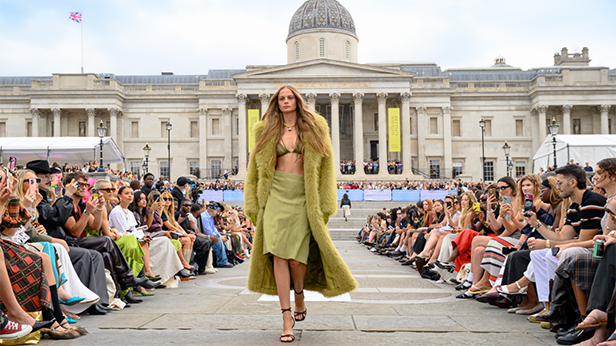
Topshop staged a runway show last week in Trafalgar Square, marking what was billed as a triumphant return for one of Britain’s most recognisable high street brands. Once the unofficial uniform provider of Oxford Circus Saturdays, the brand is now attempting to re-enter a fashion landscape that looks almost unrecognisable from the one it once dominated.
But instead of a cultural comeback moment, the show landed somewhere between nostalgia exercise and identity crisis — raising a quieter question beneath the spectacle: does anyone still actually want Topshop back?
A High Street Icon Trying to Reclaim Its Place
Topshop was once shorthand for accessible cool. It sat at the centre of British youth culture, translating runway trends into something you could afford with a weekend job. But the context it once thrived in no longer exists.
Today’s high street is defined by ultra-fast fashion, TikTok micro-trends and algorithm-driven retail cycles. Against that backdrop, Topshop’s runway debut felt less like reinvention and more like a brand revisiting its own archive.
The target audience appeared to be those who remember the Oxford Circus flagship in its peak era — teenagers turned adults who once queued under the glow of its escalators. The problem is that fashion has moved on, structurally and culturally, and nostalgia alone is no longer a strategy.
Ownership, Optics and the “British Fashion” Narrative
The relaunch has been positioned by parts of the industry as a moment of British fashion renewal. But the reality is more complicated.
Topshop is now majority-owned by Heartland, the investment company of Danish billionaire Anders Holch Povlsen, with ASOS retaining a minority stake. It is no longer a distinctly British brand, despite how it is being framed publicly.
That tension was amplified by the decision to stage its return within the symbolic space of Trafalgar Square, with the British Fashion Council and London’s mayoral presence lending institutional weight to what is, in practice, a globalised commercial relaunch.
The result is a show that feels caught between branding exercise and cultural positioning — unsure whether it is heritage revival or retail repositioning.
A Runway Built on Nostalgia
The collection itself leaned heavily into familiarity rather than reinvention.
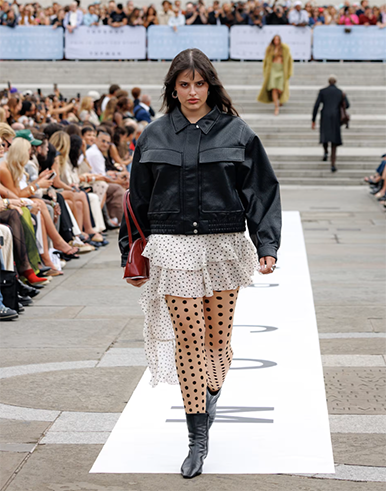
The opening look paired a bubbled faux-leather jacket with a polka-dot dress, tights and boots — a fully synthetic composition that echoed past Topshop styling codes more than it challenged them.
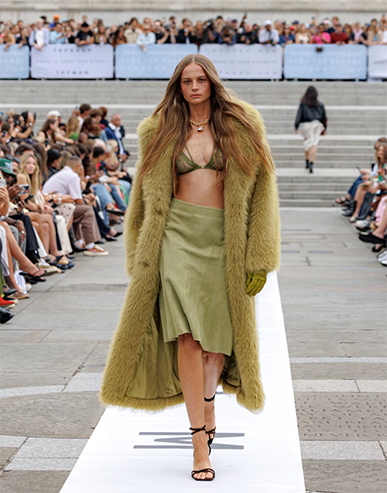
A floor-length faux-fur coat followed in Grinch-green, priced at £140, sitting somewhere between high street nostalgia and late-2010s influencer aesthetics.
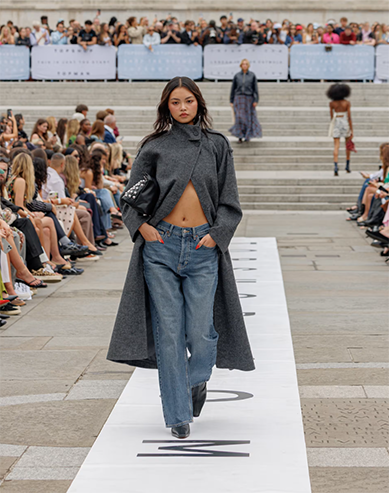
The most grounded moment came with a pair of straight-leg jeans — a reminder that denim remains one of the brand’s strongest historical categories. But one strong look does not define a reset.
Across the runway, synthetic materials dominated. Faux leather, polyester and faux fur shaped a collection that felt more aligned with fast-fashion conventions than any declared shift in quality or direction.
Sustainability Claims vs Visual Reality
According to brand representatives, Topshop’s repositioning includes improved production standards and higher-quality materials, reflected in its updated pricing strategy.
But that narrative is not clearly visible on the brand’s public-facing platforms, where sustainability commitments remain vague.
What was visible on the runway, however, was a continued reliance on synthetic fabrics — the same materials often criticised within the fast-fashion ecosystem for their environmental impact and limited longevity.
If this is a new era for the brand, it is not yet clearly articulated through either product transparency or design language.
Styling, Sizing and Who This Is For
Styling throughout the show leaned heavily on familiar references rather than contemporary reinterpretation. The result felt less like a forward-looking collection and more like a recreation of past Topshop identities.
There is also the question of inclusivity. While Topshop once expanded its reach through extended sizing and accessible ranges, the relaunch appears more limited, with sizing currently reported to cap at 18.
For a brand attempting to reassert cultural relevance, narrowing its audience at the point of return feels like a significant contradiction.
Final Thoughts: Revival or Rerun?
Topshop’s runway return was designed to signal rebirth — a moment of visibility for a brand trying to re-enter cultural conversation.
Instead, it highlighted the gap between nostalgia and relevance in today’s fashion landscape.
The memory of Topshop still carries weight. But memory alone is not enough to rebuild a fashion identity in 2025.
Until the brand can clearly define what it stands for now — not what it once was — this does not feel like a comeback.
It feels like a rerun.